Garage door diagrams, free to reuse
Every drawing on this site is original, authored by hand as SVG, and made for one purpose: to show someone standing in front of a door that will not open what they are actually looking at. There are no photographs here and never will be — a photo of a van or a technician next to a listing would imply we have seen that business, and we have not.
You are welcome to take any of them. They are more useful on your page than sitting on ours.
The license, in plain terms
These diagrams are released under Creative Commons Attribution 4.0. You may use them anywhere, including commercially, including on a competing site, and you may modify them. The single condition is credit with a link.
Copy this wherever you use one:
<a href="https://garagedoorprohq.com/diagrams/">Diagram by GarageDoorProHQ</a>, <a href="https://creativecommons.org/licenses/by/4.0/">CC BY 4.0</a>
Plain text, if you cannot use a link: Diagram by GarageDoorProHQ (https://garagedoorprohq.com), CC BY 4.0
If you modify a drawing, please say so in the credit. The reason is not vanity: these are used to explain which part of a garage door is under enough tension to injure someone, and we would rather an altered version not be read as ours.
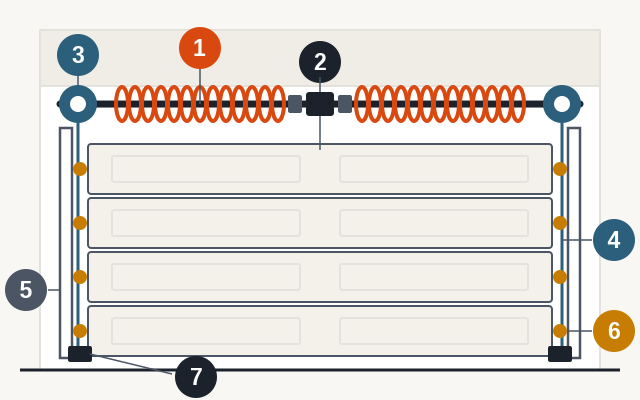
Where the load actually travels
- Torsion spring
- Torsion shaft and center bearing plate
- Cable drum
- Lift cable
- Vertical track
- Roller
- Bottom bracket — under full spring tension
Download torsion-system.svg — SVG, scales to any size, colors baked in.
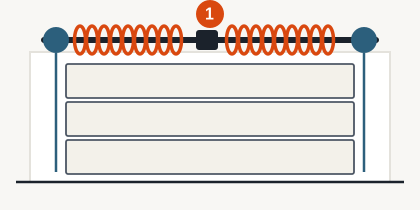
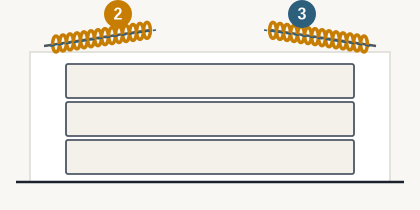
Look above your door
- Torsion springs on a shaft above the opening
- Extension springs alongside the horizontal tracks
- Safety cable threaded through the spring — ask for these if yours lack them
Download spring-types-1.svg · Download spring-types-2.svg — one file per panel. SVG, scales to any size, colors baked in.
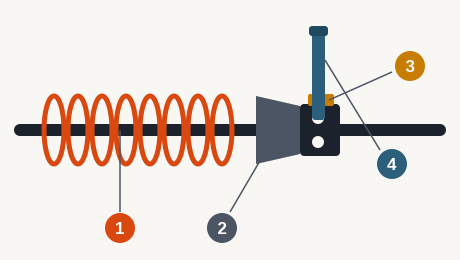
Parts only
- Torsion spring coils
- Winding cone, cast onto the spring end
- Set screws clamping the cone to the shaft
- Solid steel winding bar, correctly sized to the hole
Download winding-cone.svg — SVG, scales to any size, colors baked in.
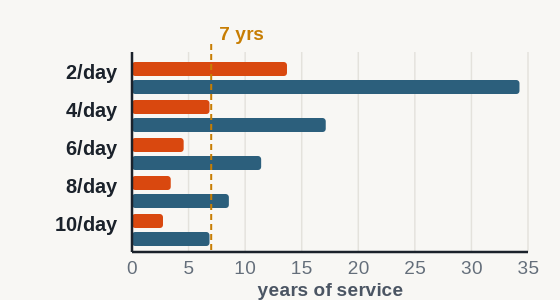
Cycle life divided by real use
- Standard spring, 10,000 cycles
- High-cycle spring, 25,000 cycles
Download spring-life.svg — SVG, scales to any size, colors baked in.
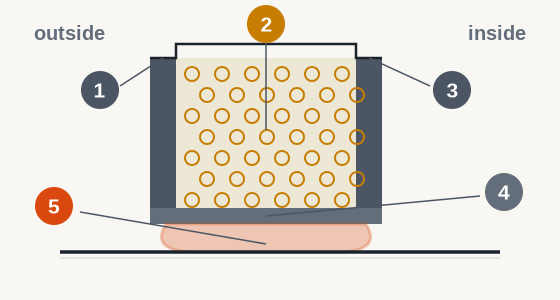
What "insulated" physically means, and where the bottom seal sits
- Outer steel skin, facing the street
- Insulating foam core — this is what R-value measures
- Inner steel skin, facing the garage
- Aluminum retainer holding the seal
- Bottom seal, compressed against the floor
Download door-layers.svg — SVG, scales to any size, colors baked in.
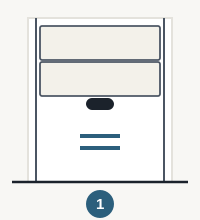
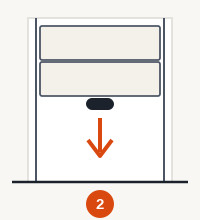
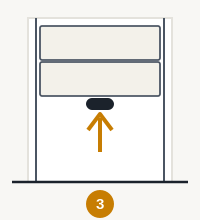
The free diagnostic, and the one that tells a spring fault from an opener fault
- Balanced — stays where you left it
- Too little tension — slides shut. Springs are the fault.
- Too much tension — pulls upward. Also springs.
Download balance-test-1.svg · Download balance-test-2.svg · Download balance-test-3.svg — one file per panel. SVG, scales to any size, colors baked in.
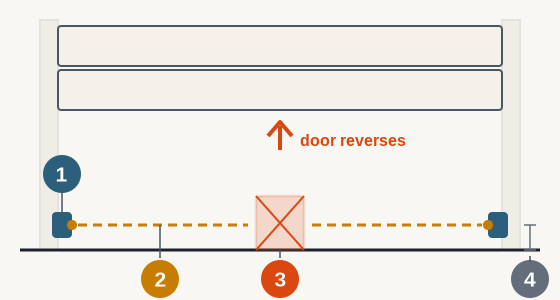
The fault that most often needs no technician
- Photo-eye sensor, one each side
- Infrared beam between them
- Anything breaking the beam reverses the door
- About six inches above the floor
Download photo-eye.svg — SVG, scales to any size, colors baked in.
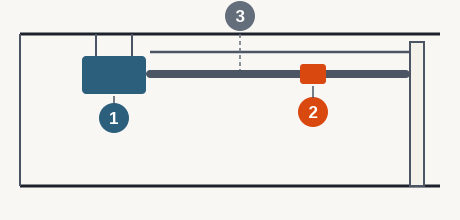
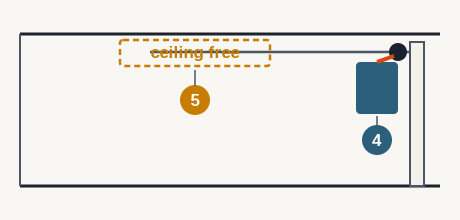
The jackshaft argument is entirely about the ceiling
- Motor unit, hung from the ceiling
- Trolley traveling along the rail
- Headroom the rail consumes
- Jackshaft motor, wall-mounted beside the opening
- Ceiling left clear for storage or a car lift
Download opener-types-1.svg · Download opener-types-2.svg — one file per panel. SVG, scales to any size, colors baked in.
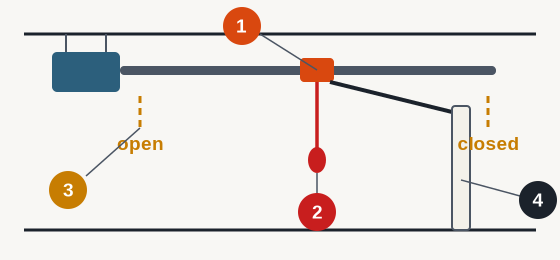
The two things on an opener a homeowner actually interacts with
- Trolley, traveling along the rail
- Emergency release cord — red, always
- Stored open and closed limits
- Arm connecting the trolley to the door
Download trolley-cord.svg — SVG, scales to any size, colors baked in.
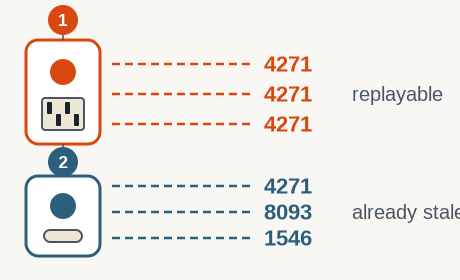
The whole difference in one picture
- Fixed code — note the DIP switch bank inside older remotes
- Rolling code, on every current opener
Download rolling-code.svg — SVG, scales to any size, colors baked in.
What is not here, and why
The cost map that appears on the repair-cost guide is missing on purpose. Its numbered markers are matched against that guide's own price table and the figures render in the legend beside it, not inside the drawing. Released as a standalone file it would be a set of markers pointing at prices that are not in the file — easy to pair with someone else's numbers, and impossible for us to keep honest. Prices belong with the guide that owns them.
The homepage illustration is also not here. It is decorative rather than explanatory, and there is nothing to label on it.
Found a mistake?
These are drawn from manufacturer documentation and trade practice, not from site visits. If something in one is wrong, tell us and we will fix the drawing rather than argue about it: contact@garagedoorprohq.com.